
Friedrich’s Wanderer above the Sea of Fog: pictorial analysis and romantic reading
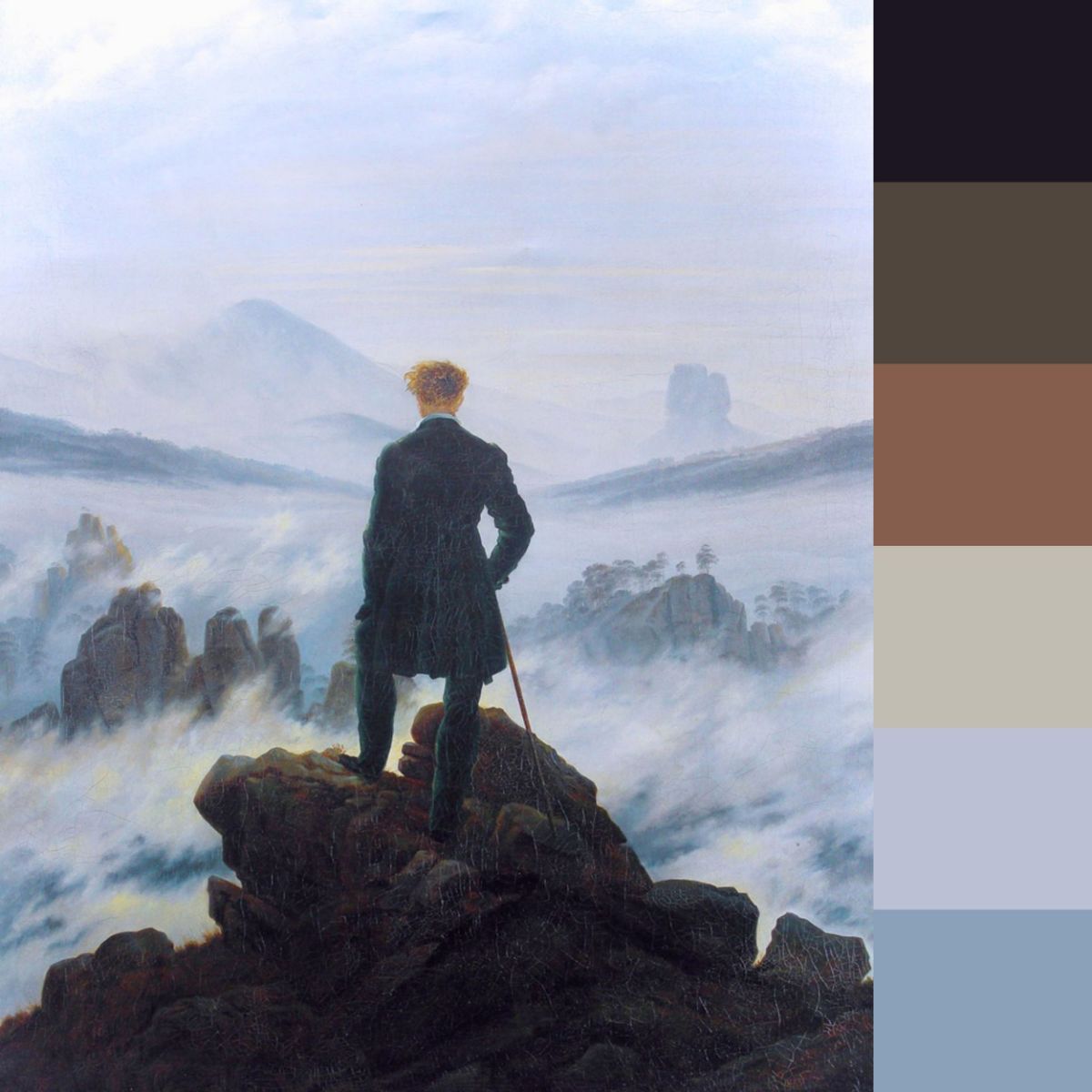
Painted in 1818, Wanderer above the Sea of Fog embodies Friedrich’s romantic vision. Man stands alone before the infinite, facing nature’s grandeur. Both realistic and symbolic, the work meditates on solitude and spiritual elevation.
This work may also be reproduced as a hand-painted copy, based on the original and respecting its color and composition.
Visual reading and composition
Values shift from dark rock to bright sky, forming a vertical gradient that builds depth. The black silhouette of the wanderer stands sharply defined, the visual pivot of the scene. The cliffs’ diagonals direct the gaze toward the horizon, opening the space to immensity. Balance between contrast and softness gives contemplative power.
Focal point and gaze structure
The focal point is the lone figure seen from behind, his dark form cutting across the sea of clouds. The cliffs’ diagonals and his upright posture guide the eye toward the horizon, inviting the viewer to share his contemplation.
Atmosphere and message
By opposing values, focusing on the wanderer, and arranging monumental forms, Friedrich expresses man’s confrontation with infinity. The painting becomes a romantic meditation on nature’s sublimity and the inner experience of the infinite.
A copyist’s eye
Copying this Friedrich means breathing light like air. Grays, blues, and ochres must blend yet retain depth. The modeling of rock and sky demands slow, meditative transitions. The central figure is rendered with restraint. Painting it teaches that light does not describe — it reveals infinity within the human gaze.
This pictorial approach also informs the copies of Caspar David Friedrich’s works created in my studio.
Going Further


ARTISTE DE PARIS
Christian Denéchaud, artiste peintre
50 avenue des Champs Elysées
75008 Paris
SIRET 452248461
FR90452248461
.png?t=)
© Artiste de Paris . fr - 2026