
Cézanne’s L’Estaque and the Château d’If: pictorial analysis and visual reading
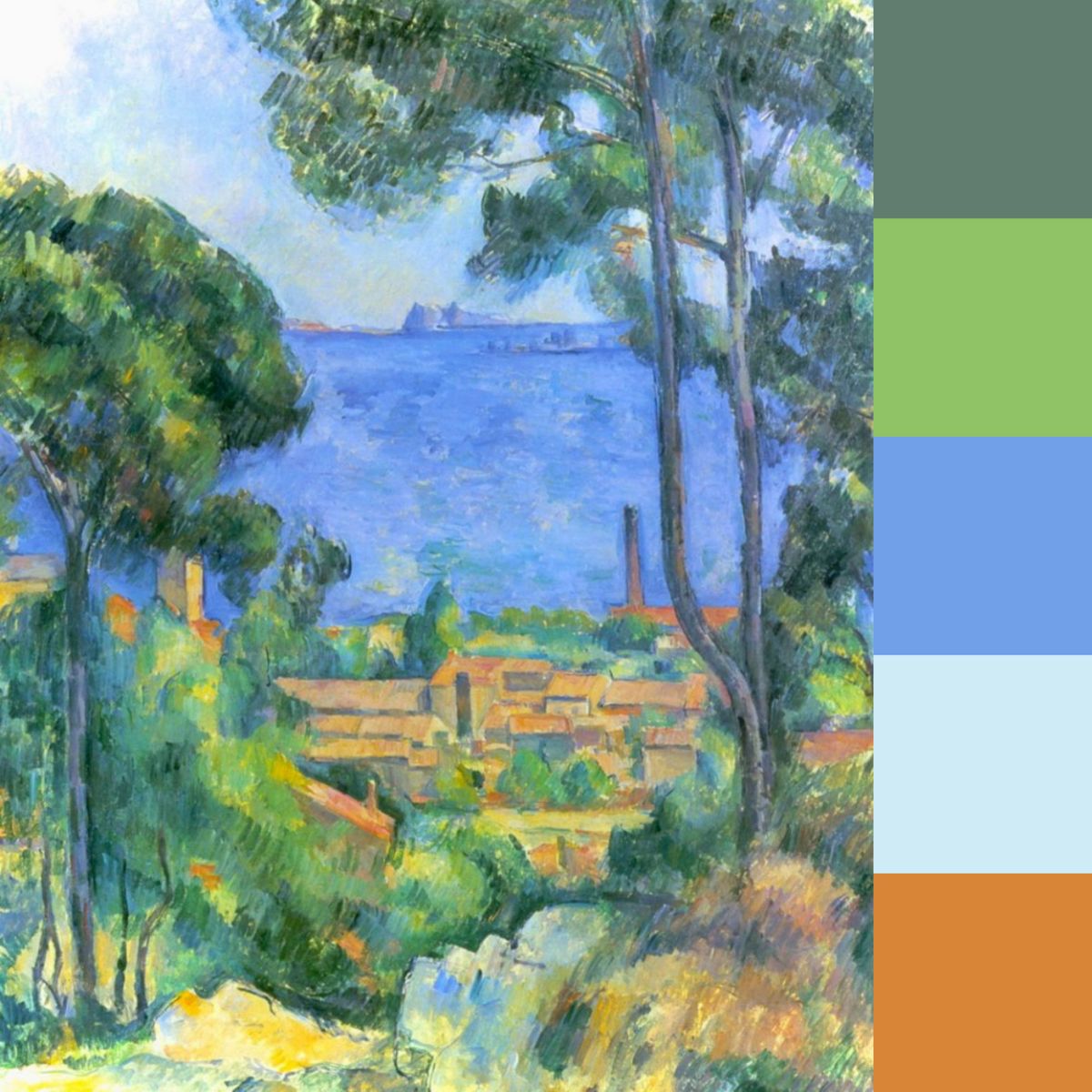
Painted between 1883 and 1885, L’Estaque and the Château d’If reflects the period during which Cézanne explored the structure of the Provençal landscape. From the hill of L’Estaque, he observed the Marseille harbour and translated Mediterranean light into solid forms and coloured volumes. The work marks a step toward the constructive pictorial language that would inspire Cubism.
This work may also be reproduced as a hand-painted copy, based on the original and respecting its color and composition.
Values and colour balance
The light values of the sky and sea contrast with the darker tones of the hills and houses. These ordered masses establish an almost architectural balance. Each plane stands out through shifts in colour rather than drawing, giving the landscape an inner stability. Unity comes from the coherence of blues and ochres, subtly modulated to express Southern light.
Focal point and eye organisation in Cézanne
The focal point lies in the bright band of sea and the Château d’If emerging from it. The oblique lines of the hills and the construction in successive planes guide the eye toward this horizon. The gaze moves without interruption thanks to the precise articulation of colour masses and the balance between lit and shaded surfaces.
Atmosphere and visual message of Cézanne’s landscape
By combining structured values, a discreet focal point and geometricised forms, Cézanne transforms a Mediterranean view into a manifesto of modernity. The landscape is not merely descriptive: it becomes a pictorial architecture, a reflection on spatial construction. The work expresses a vision in which nature and painting merge into a lasting harmony.
A copyist’s eye
Copying this Cézanne means understanding how colour builds volume. Each plane requires firm paint, laid without overmixing, to preserve vibration between tones. The composition rests on the balance of masses, where every brushstroke supports the structure of the landscape. Nothing is decorative: everything contributes to visual architecture. While painting, one senses the silent emotion behind the rigour — the search for order without extinguishing the Southern light.
This pictorial approach also informs the copies of Paul Cézanne’s works created in my studio.
Going Further
ARTISTE DE PARIS
Christian Denéchaud, artiste peintre
50 avenue des Champs Elysées
75008 Paris
SIRET 452248461
FR90452248461
.png?t=)
© Artiste de Paris . fr - 2026