
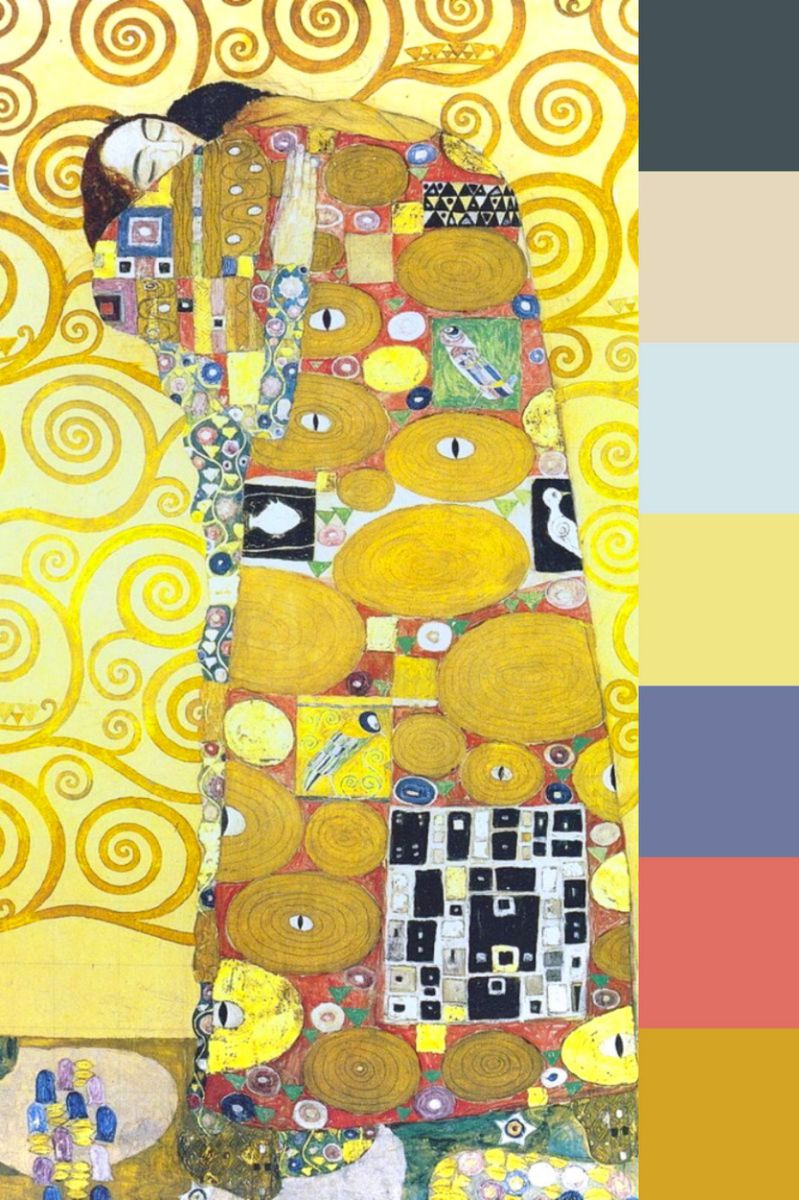
Klimt’s Tree of Life (detail from The Embrace): analysis and visual reading
Designed 1905–1909 for Brussels’ Stoclet Palace, the Tree of Life crowns Klimt’s decorative style. He unites gold, symbol, and movement to celebrate continuity among nature, love, and spirituality — a sensual, mystical synthesis of Vienna Secession ornament.
This work may also be reproduced as a hand-painted copy, based on the original and respecting its color and composition.
Visual reading and composition
Values rest on luminous gold ground contrasted by darker spiral and figure areas. This play of light and shade brings out the focal point: the tree’s vertical and the “Embrace” silhouette. Forms, dominated by coiling motion, create continuous dynamism. Large gold masses unify the surface while colored motifs pace reading without breaking decorative harmony.
Dynamics among spirals, figures, and gold masses
Spiral ornament drives a moving visual rhythm, guiding the eye from motif to motif. The focal point on tree and couple asserts itself through opposition between bodily geometry and fluid arabesques. Broad gold fields stabilize the whole, while colored details add lively counterpoint.
Symbolic, timeless atmosphere
Brilliant values, focus on the tree, and ornamental forms produce solemnity and mystery. Klimt turns nature into a universal symbol of life and union, giving the work a decorative and spiritual aura beyond figuration.
A copyist’s eye
Copying the Tree of Life balances draughtsmanship with ornamental freedom. Gold must not shine uniformly: nuanced passages suggest depth and relief. Spiral lines require a steady, living hand. The challenge is marrying graphic precision to chromatic vibration, until light itself becomes symbol.
This pictorial approach also informs the copies of Gustav Klimt’s works created in my studio.
Going Further
ARTISTE DE PARIS
Christian Denéchaud, artiste peintre
50 avenue des Champs Elysées
75008 Paris
SIRET 452248461
FR90452248461
.png?t=)
© Artiste de Paris . fr - 2026