
Leonardo da Vinci’s Lady with an Ermine: analysis and pictorial reading
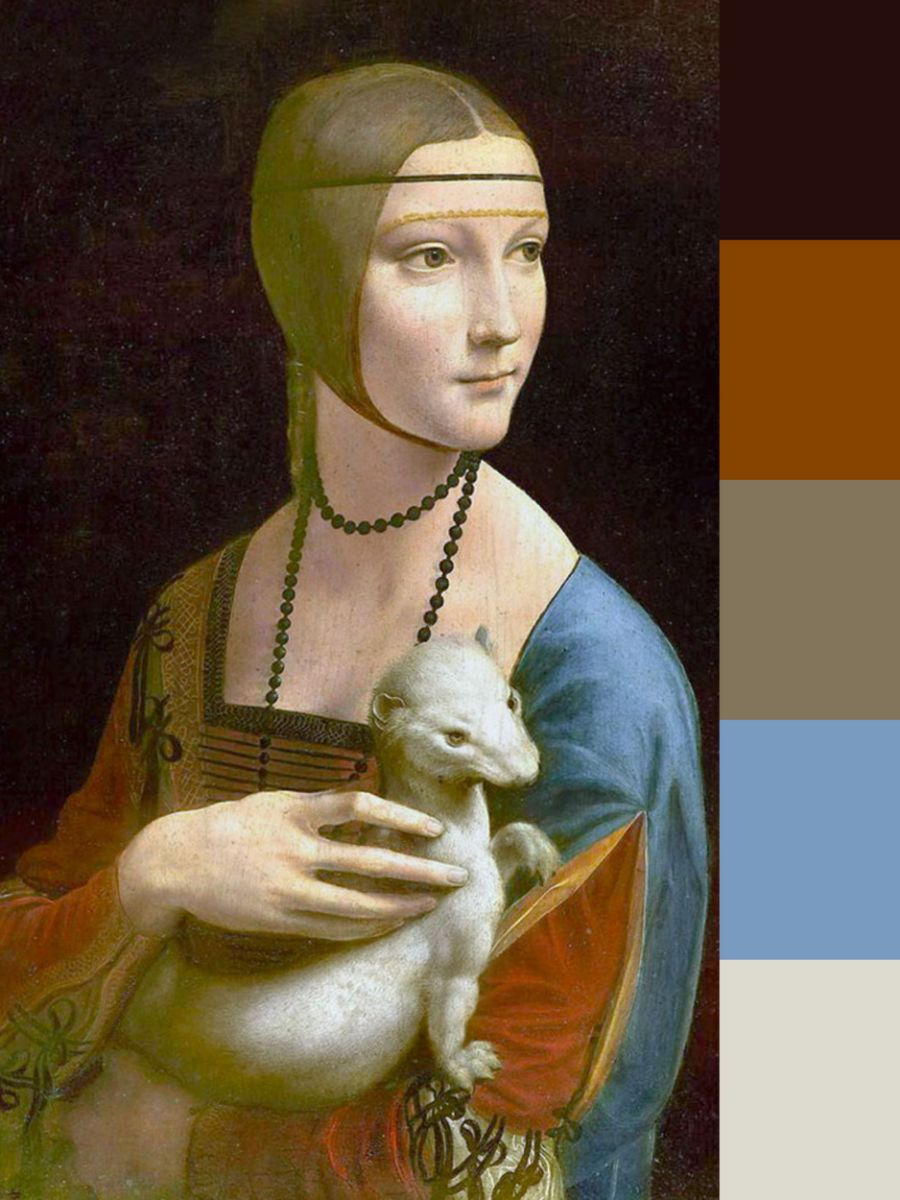
Painted around 1489–1490, Lady with an Ermine depicts Cecilia Gallerani, favorite of Ludovico Sforza, Duke of Milan. Leonardo deploys the full finesse of his portrait art: balanced values, gentle modeling, and the contained tension of gesture. The work combines elegance, restraint, and psychological intensity within luminous unity.
This work may also be reproduced as a hand-painted copy, based on the original and respecting its color and composition.
Visual reading and composition
Values are organized between the brightness of face and hands and the darker areas of garment and background. This contrast leads the eye to Cecilia, whose face—modeled by delicate transitions—becomes the luminous center of the painting. The dialogue between the line of her gaze and the curve of the ermine balances the composition. Simple masses and precise details unite in calm, measured harmony.
The dialogue between human figure and animal
The portrait’s refinement rests on the balance of forms: the oval of the face and the curve of the ermine converse harmoniously. The focal point is reinforced by the direction of the gaze and the gesture of the hands, which subtly guide the viewer. The composition varies between large, stable masses and minute details, creating a fluid, elegant rhythm.
An atmosphere of elegance and vitality
The combination of contrasted values, the clear focal point, and varied forms gives the portrait a sense of nobility and inner life. Leonardo goes beyond likeness to capture the grace and psychological subtlety of his model, granting the work an aura that feels timeless.
A copyist’s eye
Copying Lady with an Ermine means seeking balance between precision and breath. The facial modeling must arise from imperceptible blends, light gliding without breaks. Flesh tones require transparency and disciplined gesture. The ermine, softly white, should not compete with the figure; it prolongs her grace. In painting, one understands that Leonardo does not show a woman—he reveals a thinking presence.
This pictorial approach also informs the copies of Leonardo da Vinci’s works created in my studio.
Going Further

ARTISTE DE PARIS
Christian Denéchaud, artiste peintre
50 avenue des Champs Elysées
75008 Paris
SIRET 452248461
FR90452248461
.png?t=)
© Artiste de Paris . fr - 2026